Friday, May 8, 2015

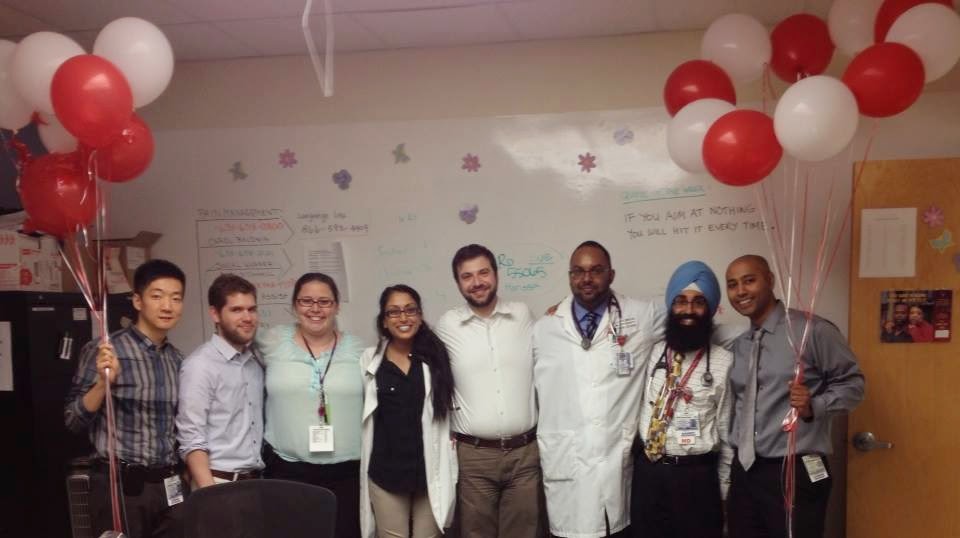
Happy Nurses Week!

     It's nurses week and it's very important that we recognize the critical role they play in all facets of healthcare. Personally through the years I've had the pleasure of working with amazing nurses in a variety of settings. Here are some examples of what I've learned in terms of working with nurses and the important work they do every day.
    Just like most things in medicine, I had to learn how to work with nurses. As a resident, I didn't have any curriculum on team based multidisciplinary care. I had to learn things on the fly and rather quickly. I spent the majority of my internship in hospital wards where life was extremely fast paced with incredibly complex patients. I took pride in the fact that my senior residents and attendings looked to me as the "eyes and ears" of the team. But soon into internship I felt I needed help and my own sets of extra eyes and ears. Once I recognized that nurses were my partner and not my subordinate, my entire experience and education changed. Nurses were not only executing my ideas, but providing valuable feedback to help troubleshoot issues and allow the formulation of better and more efficient plans. In the busy chaotic world of hospital medicine, where medical mistakes happen far too often, it is imperative that everyone on the team are on the same page. As an intern, I tried to accomplish this by touching base with my patient's nurses, even if it was for just 15 seconds to get feedback and let them know what I was planning to do. For any future doctors out there reading this, I can't emphasize enough what a valuable lesson this was.
     After residency, as my career took a direction towards the outpatient world I saw a different but just as vital role that nurses play for our patients. I took a locums tenens solo practice job in a rural part of the country. It was just me, a nurse and an administrative assistant running an entire practice. Since this was a small town, the nurse knew the patients far better than I could've ever hoped to. She gave me insight into their lives, struggles and social dynamics that really helped me tailor my medical decision making. She also advocated for me since many of the patients were skeptical of this new doctor fresh out of training. Most incredibly, this nurse was a single mom who had Crohn's disease and 2 children. She would occasionally come to work during mild flares of her illness in obvious discomfort. She avoided taking days off because she knew I needed her and most importantly her patients needed her. I would suggest that all doctors get to know their nurses on a human level. You will be amazed at the passion with which they play their role in medicine.
     Finally, when my career took a turn towards academics, I worked full-time in a continuity clinic for internal medicine residents. For those that may not know, in a continuity clinic, faculty supervise  interns and residents delivering outpatient care. The patients are usually quite complex, challenging with many social issues. To complicate the matter further, the interns and residents can vary extensively in clinical acumen, effort and general interest in this responsibility. This combination of patient and trainee can be a combustible mix that results in suboptimal care. That is of course if you don't have an incredible nurse to compensate and account for everything that could possibly go wrong. The nurse I am referring to was critical in many ways for creating a successful educational experience for trainees while delivering excellent care . She would often pick up important issues and clues from patients to relay to the residents and thus make their jobs easier. She would advocate for the trainees if there was a dissatisfied patient. For the trainees that befriended her, she became a confidant and or loving mother like figure. She gave feedback to trainees directly and to me as faculty if something egregious went unnoticed. She had an endless supply of jokes and feel good chocolates to lift their spirits when the days were trying. Her presence was a vital reason why the important educational experience of continuity clinic became something trainees looked forward to rather than avoid. 

     So a special thanks to all the nurses out there in my life, past present and future. You are a driving force in our healthcare system. I'm excited that as we look to innovate and improve our healthcare system, we are all looking to you to be a vital partner in solving some of our biggest problems. Happy Nurses Week!

Labels: , , , , , , ,

Friday, April 24, 2015

Coming full circle, 15 years later

     This week, I had the pleasure of participating in an information session for my medical school Alma Mater, St. George's University. The entire experience was a bit surreal when I realized that almost 15 years ago I was one of those faces sitting in the audience, taking notes and wondering what lies in my future.
      Like many of the students that were sitting in front of me, I had doubts. I had doubts about my prospects getting into a US medical school. I also had doubts about whether going to a foreign country for my medical education would be the right decision. Standing there in front of them, I was genuinely happy to report that it was absolutely the right decision.
      It was the right decision for many reasons. First, I came away with some incredible friends, one of whom is actually getting married in a few weeks in what will be an incredibly fun reunion in Hawaii. More importantly, despite all my initial doubts, I came away with a great education and an opportunity to pursue a truly gratifying career. My other really good friend from medical school used to quote the movie Spiderman and tell me,  "When you doubt your powers, you give power to your doubts." My belief in myself and the support of St. George's eliminated those doubts and allowed me to excel in my professional life.
     I told my audience at the information session that at times when I was medical student, I wondered if I was as knowledgeable as my counterparts from other schools. As a resident, I also wondered if i was up to par with residents from other schools. 15 years later, I realize the answer was and always will be a resounding yes. Not only that, in my current career path as an academic internist, I'm responsible for teaching those same students and residents that I compared myself to many years ago.
     Ultimately, doubting yourself or comparing yourself to others at any point in your career is a futile and worthless effort. The fact is, we all somehow end up in the same place, which is in front of a patient in need. Everyday I am grateful for that opportunity. And as the number of those patients in need continue to rapidly grow in our country, it's great that St. George's is continuing to produce a steady stream of excellent doctors that are looking to make a difference just as I did 15 years ago.
   

Labels: , , , ,

Friday, April 17, 2015

The Ironic Illness of Izzy

     When I first met Izzy (name changed) he was a portly elderly gentlemen with an effervescent and jolly personality that lit up the clinic every time he visited. His most recognizable feature was his voice. His lifelong hobby was singing opera, as a tenor. The first time I discovered this, he belted out a few lines that echoed through our entire clinic. It was marvelous and since that moment, I always made sure my medical students and residents not just saw him, but heard him as well. He was a spectacular patient and person.
    A few years from our initial encounter, I found myself wandering the halls of the hospital with 2 medical students. They were 2nd year students looking for patients to practice taking histories and doing physical exams. Earlier that day, I received word that Izzy was admitted. Though this was unfortunate for Izzy, it was fortuitous for my fledgling doctors that such a great patient was available to talk to. And not surprisingly, despite feeling unwell, Izzy with his wife by his side, welcomed my students openly.
     I stood off to the side of the room, while my students peppered him with questions for over an hour as they tried to piece together his medical history without much experience and medical expertise to fallback on. They learned about his vocal talents and though he wasn't well enough to sing on that day, Izzy was quick to point out how his voice swept his wife off her feet when they were in college. I thought I knew everything about Izzy from our several appointments together, but these medical students were able to illicit a entirely new story from him that even I was unaware of.
    My intrepid students were taking a travel history when they discovered his wife was originally from  South America. He reminisced about the last time they went to visit her family which was about 4 to 5 years prior. He fondly recalled staying near a seaside town, enjoying the fresh ocean air and wonderful local cuisine. The only thing he didn't enjoy about this trip was going further inland to visit in-laws living in more mountainous areas. He recalled getting sick during that part of the trip, blaming it on some bad food and lack of sleep. His wife reminded him that he almost passed out a few times that week from feeling so unwell.
     After almost 90 minutes of questioning, doing a physical exam and sharing lots of laughs, my students and I left Izzy to go debrief on everything we had talked about. There was just an incredible amount of things to learn from Izzy. We were able to weave together his history, his physical exam, basic pulmonary physiology, and pathology to explain what had happened. I described to the students that Izzy was suffering from pulmonary fibrosis and explained some of general facets of this illness including impaired gas (oxygen) exchange and just the progressive reduction in his lungs' abilities to perform . We reviewed oxygen disassociation curves and the effects of altitude and oxygen saturation. In light of his diagnosis, it became clear why with his reduced lung function and thinner mountain air, Izzy felt so ill on his vacation. This was probably one of the first signs of his illness until later when it became sadly obvious his opera singing days were coming to an end.
     With every patient, there's always something to learn and Izzy's story was no exception. For me, when I look back at his story, I began to appreciate medicine as something more than doctors treating individuals with specific diseases affecting affecting well defined anatomy through different but predictable mechanisms. Medicine, as a science has surprisingly very abstract human qualities. At times, it can be funny, or sad, thrilling, uplifting, unpredictable and often dramatic. When an opera singer that relied on powerful lungs got a relatively uncommon condition affecting those same lungs, medicine got my attention that it also has a knack for irony.


Labels: , , , , , , , ,

Wednesday, April 15, 2015

OMG, you're alive!

     As a  physician, it's great to revisit the medical miracles you've played a hand in. In the monotony of the common every day events, a visit from that one patient who you brought back from the brink, can really lift the spirit. These moments are rare, especially if they happen while you're a medical student or resident that is destined for a short stay in the community, never to see that one incredible patient again. Even if you stay in one place for a few years, many patients get lost to follow up (for a variety of reasons) and the curiosities for whatever happened to Mr. or Mrs. X  can fade over time.
     As a 3rd year surgical med student, I remember attending trauma clinic and following around a weary 5th year senior resident (Dr. HC) as he lurched from room to room in his scrubs and clogs doing post op checks and removing stitches with little enthusiasm but great urgency. Clinic was a chore, an obstruction from the operating room or his call room bed. One day he picked up a chart of a gentlemen Mr. D (name changed) who presented with stitches that were surfacing from his abdomen from a trauma surgery a few years prior. He knocked on the door while reading the chart, entered the room head down while still reading and introduced himself... while still reading. When he finally looked up, he stopped suddenly, grabbed his mouth and mumbled "Oh my God!"
     3 to 4 years prior, when Dr. HC was a lowly surgical intern on trauma call, he assisted on a lengthy operation on a young Rastafarian gentlemen that suffered multiple knife wounds to his abdomen. I don't recall the details of the surgery but Dr. HC made it clear to me, that he didn't expect this patient to survive once he was patched up and shifted to the intensive care unit. The patient had a lengthy stay in the hospital and despite the visceral experience of doing surgery on him, Dr. HC's gypsy, sleep deprived surgical life turned Mr. D into simply another case to log and a patient unwillingly forgotten.
    After a few more seconds of disbelief, Dr. HC was finally able to drop his hands from his mouth and give Mr. D a  handshake. Mr. D's chief complaint  were put on hold while I was told about the circumstances of how they 1st met. Mr. D actually didn't even know who his doctors were on that terrible day but was pleasantly surprised to hear that this random resident sent to remove some stitches today, helped save his life. But Mr. D's enthusiasm was tempered, probably due to the discomfort he was feeling that day,the difficult post op course, rehabilitation and numerous nutritional issues he'd been battling ever since his abdominal trauma. But nothing could temper Dr. HC's smile as he grinned from ear to ear, repeating several times " Man, I can't believe it's you. "
    Dr. HC was a battle weary 5th year surgical resident, in a bleak inner city hospital. During my 12 weeks as a surgical med student, he was generally pleasant but had always had a morose aura. His chance encounter with Mr. D was the first time, he looked genuinely happy. In one of those very important "teachable moments" that med students crave, Dr. HC emphasized that it's cases like Mr. D that keep you going. It was a valuable lesson and although I didn't become surgeon, I did become a much better doctor that day.

Labels: , , , , , ,

Monday, March 16, 2015

Learning, food and great memories

I had a few minutes so I thought I'd try and collect some of the many pictures taken at my last job that capture the spirit of learning combined with the fun and joy of eating together like a family.

At least a couple of times a month, we would hold pot lucks at our clinic while we did our Friday afternoon outpatient noon conference. They often a had a theme such as "Pi day"where we all made/bought some form of a pie.

The work we did in that clinic was often quite difficult but small events like these really made the work and learning process so wonderful!

Lot's of great memories and I miss all of you!


Labels: , , , , , , ,

Thursday, December 4, 2014

Endings and Beginnings

It's been a while since my last post. I've been busy and life has been changing.

For one, we had our third baby! She's beautiful and certainly takes up a significant amount of our time (disproportionately at night!)

I'm also moving. After a lifetime of calling myself a New Yorker, we're packing up and moving to Dallas, Texas.
I will always be a New Yorker and the emotions regarding this change are far too complex to discuss on this post.

But with this move ends a tremendous chapter of my medical life. Much of my posts on this blog were based on stories and experiences from these past 5 years.

We go into medicine because of the patients. The patients and their stories will always be the crux of my life in medicine. They will always inspire me to write and keep practicing medicine.

But these past 5 years have been about more than patients. I also took care of a different group of people. I got to be a caretaker of some pretty incredible internal medicine and med-peds residents.

They inspired me, taught me, challenged me, tested  me, made me laugh but most importantly made me proud to be a medical educator.

As doctors we love making patients better. As medical educators we love making patients better and making doctors better. It's an incredibly fun and gratifying career path.

So with that, a sincere thank you and good bye to my trainees past and present. I hope your interactions with me were as meaningful to you as it was for me. I can't wait for our paths to cross again as professional colleagues.

To my new patients, I can' t wait to meet you all and take care of you

To my new trainees, I can't wait to meet you all!. Let's get to work to make healthcare better and change medicine!

Labels: , , , , , , , ,

Monday, February 17, 2014

Wegener's and Wikipedia on a cold winter morning, 2008

     The year was 2008 and I had a real swagger about me. After another long Philadelphia winter, the calendar was about to flip to March and spring. More importantly, the end of my internal medicine residency was within reach. It seemed like every day, I was doing something else for the last time. My last admitting shift, my last ICU rotation, my last 30 hour call. These were the many little aspects of a grueling residency that seemed so terrible at the time, but today is a memory I'm proud of.
     I carried that same swagger into my last morning report presentation. A miraculous catch by David Tyree and a Super Bowl victory by my New York Giants gave me the confidence to present my case with ease despite an audience full of Philadelphia Eagles fans. I presented a case about a gentleman that I had admitted for acute renal failure from Wegener's Granulamatosis. It was a great case that generated a lot discussion between students, residents and faculty. I concluded my presentation like others by reviewing some of the evidence and literature for its treatment. With my last PowerPoint slide, I paid homage to my interests in medical history by revealing the onerous story behind the gentleman for whom Wegner's was named. German pathologist Friedrich Wegener apparently had ties to the Nazi regime.
     My digression into medical history was well appreciated. It was a welcome break from discussing antibodies, drugs and the pure science of my case. I looked across my audience and started to notice eyes perk up as the decibel level in the room slowly increased while my presentation neared its end. I concluded my digression about the infamous Dr. Wegener by displaying my reference. It wasn't a journal or a textbook. It was "Wikipedia, The Free Encyclopedia that anyone can edit."
     My reference was met with a variety of reactions. There were those who looked confused and probably had never heard of Wikipedia. But there were those who laughed and found the reference humorous or perhaps comical. I wasn't surprised by the laughter or snickers. My residency and its faculty prided themselves in the strong academic traditions of evidence based medicine. Some residents even hesitated to cite established resources like The Washington Manual or Up To Date because it wasn't JAMA, or NEJM or Annals. I suspect back in 2008, a reference to a quirky online fad where any Joe or Jane could pose as an "expert" had little or no place in the halls of medicine academia. But as far as I could tell, the world was changing.
    Wikipedia is obviously not a fad. It is rapidly becoming the go to reference for everyone. Since 2008, the number of articles on it has doubled to 32 million, 4.5 million in English. Back in the day, I had a 25+ volume edition of the encyclopedia Britannica. I used it for all my school projects and I never questioned its authenticity. I never checked up on its references. I accepted it as truth and it got me through my academic life until Wikipedia. Modern education systems are and should rely on Wikipedia as a vital information resource just as I did with Britannica. In my opinion, Wikipedia is a monumental leap forward in civilization since it has democratized knowledge by taking the price tag off of it and allowing every citizen to contribute. One could even argue, it is everyone's civic duty to contribute to Wikipedia, just as we expect everyone to pay taxes or perform jury duty.
   In medicine we love our traditions and the knowledge that we guard is sacred. We also have a very high standard for the quality of that knowledge. It's part of the reason why we will probably be the last to accept Wikipedia as a legitimate source of information. But it's already happening whether we like it or not. In my own social media study at my institution, nearly all the students who responded are using Wikipedia for both personal and professional reasons.

Social Media in Medical education student survey, Blog Post

In my day to day work with residents and students, Wikipedia is a fast, quick reliable source of pulling up a variety of types of information. I find it especially useful pulling up basic sciences information (anatomy, biochemistry, physiology etc) which is often forgotten in the fast paced clinical real world.

I think medical academia is finally understanding that we cannot hide from the digital world and that we should understand it, participate in it and help shape its future. The University of California in San Francisco medical school is embracing this.

UCSF First US Medical School to offer credit for Wikipedia articles.

The Cochrane collaboration will also be partnering with Wikiproject  Medicine to help advance this movement.
Cochrane + Wikimedicine

These are just a few examples of how medicine is embracing something like Wikipedia and the body of literature supporting it is rapidly growing. It is part of the ongoing evolution of medicine as it looks to reshape its concept of knowledge and in the process better meet the educational needs of the next generation of physicians.

Labels: , , ,

Thursday, December 5, 2013

Top 10 reasons I use Twitter in Healthcare


I’ve been on Twitter for almost a couple of years now and when I talk to people about it, I still get a healthy dose of skepticism.
So I've put together a top ten list of why as a physician and medical educator, I use Twitter.

10: Connecting with Leaders
To be lead, you must know what your leaders are thinking. Twitter has made leaders accessible. Now, instead of spending time looking for their opinions or hoping to catch a handshake or meeting at a conference, they send their thoughts directly to me, in small increments of 140 characters, everyday!

9: Connecting with Followers
As physicians, you are a leader. Whether it ‘s in your office, your patient panel, your learners, your colleagues, your academic society, you have the opportunity (and responsibility? ) to lead and lead effectively. Twitter allows you to share your thoughts in small increments, reach a vast audience with minimal effort. Quoting #10, “To be lead, you must know what your leaders are thinking.”

8: Networking
The importance of professional networking cannot be understated. Twitter easily connects people with similar interests. In less than 2 years, I have been able to access a vast network of people interested in things that are important to me such as Primary Care, Medical Education, Social Media, Evidence Based Medicine and Healthcare Technology. In the past, networking for me occurred in spurts, at pre-determined locations over a finite period of time. With Twitter, networking happens 24/7, with little effort no matter where you are (and in your pajamas, while watching tv!).

7: It makes me an active learner.
All through my education I took notes. Writing things down helped solidify that piece of knowledge. A notebook was also useful for exams, reviewing and reinforcing information. Now instead of a notebook, I have a tablet and instead of a piece of paper, I use twitter. The 140 character limitations forces me to be succinct which makes my virtual notebook very easy to review.

6: I can educate the world
This is a grandiose statement, but Twitter makes it real. As a Medical Educator, I take pride in being able to influence the learners in my immediate proximity. With Twitter I can take all those notes  (See reason #7) and broadcast it to learners in other cities, states, countries and continents! Currently I’m using the the hashtag #sbmgr to broadcast what we’re learning in our Internal Medicine Grand Rounds every Wednesday 8:30 to 9:30 AM.

5: I can attend multiple conferences simultaneously, year round.
Until human cloning technology advances, Twitter is the best way to be at multiple places at once.  I wish I could attend every medical conference out there. But thanks to people who prescribe to reason #7, I can virtually attend other conferences through my smart phone, all throughout the year. There are thousands of people out there like myself, live tweeting from conferences. This year, I personally attended ACP and APDIM live tweeting from both. But in addition, while being back home, I followed the tweets from Kidney Week and Chest in the past couple of months.

4: It’s a forum for debate
Healthy debate is part of our lives as physicians. New guidelines and treatments are always coming up, and Twitter I get immediate access to viewpoints from a wide variety of people. I often get immediate feedback on my own opinions.

3: My mom taught me to share
We are all online, all the time. As a physician, I’m always finding a great journal article, an interesting blog,  or an important news article. Before twitter, I had no mechanism to share that, besides e-mailing to a small set of people or writing it down somewhere and hope that I have an opportunity to suggest it to people. Now, every website has a Twitter link. You see something cool, you can share it with a large audience with just a few clicks.

2: The world at any given moment
Whenever I have a free moment, Twitter  is my go to activity. In 2 minutes, I can scroll through a myriad of messages and get a burst of information from a network of my choosing.  So it’s whether pumping gas, waiting for an elevator, a 15 minute lunch, a commercial break during the football game, Twitter helps me use these small snippets of time, constructively.

1: It broadens my mind
In patient care we are emphasizing a team-based approach that values the roles of every individual in a healthcare team. The same can be said for my continuing medical education. I think I have something to learn, from everyone. As a result I follow folks in Internal Medicine, sub-specialties, family medicine, psychiatry, surgery and so on. I follow nurses, physical therapists, social workers and patient advocates. I follow patients (not my own) sharing the story of their medical conditions. I am learning something from everyone from the palm of my hand.

If this doesn’t get you interested in Twitter, here’s a a blog post from someone who’s listed 140 Health Care uses for Twitter
In addition, here’s another post to help you make the leap.

Top Twitter Myths and Tip  by Dr. Vineet Arora who is Director of GME Clinical Learning Environment Innovation and Assistant Dean of Scholarship & Discovery at the Pritzker School of Medicine for the University of Chicago.

Labels: , , ,