Wednesday, June 3, 2015

A Muslim doctor gets on an airplane...

     The recent events of Tamera Ahmed on a commercial airline and the alleged discrimination and Islamophobia she endured, got me thinking about my own experiences in the air. Fortunately, I have never experienced anything as blatant as the events described by Ms. Ahmed. But as a Muslim-American, I've become too keenly aware of the growing specter of Islamophobia across the world. Whether it's at a TSA security checkpoint, sitting at a terminal or falling asleep inside the plane, I have to admit I sometimes wonder if someone is watching me, thinking I'm capable of committing harm. To those that continue to subscribe to beliefs that all Muslims on an airplane are a potential danger, I offer my own personal experiences that are the opposite.
     I've had the privilege of twice responding to a request for medical assistance on an airplane at over 30,000 feet. The first time, I was a senior resident flying home with my wife from a well deserved vacation. The flight attendant requested anyone with medical training to assist a passenger who had collapsed near the forward bathrooms. Without hesitation, I looked at my wife and headed to the front of the plane in my jeans, t-shirt and baseball cap looking nothing like a physician or a stereotypical dangerous Muslim for that matter. I ended up converging at the front with a nurse and a radiologist on the flight. Without access to a CT scanner on the flight, the nurse and I quickly took charge of the situation :-).  We came to the conclusion the the elderly lady had a vasovagal episode brought on by a lack of sleep, and the effects of alcohol at high altitude on a body altered by gastric bypass surgery. The flight attendants were understandably worried and repeatedly asked me whether the flight needed to be diverted for an emergency landing. I reassured them and gave my blessing to press forward towards our intended destination. After the flight I caught up with the lovely lady outside in the terminal while paramedics assessed her. She was extremely gracious in expressing her gratitude. In addition to her, several random passengers expressed their appreciation. One gentleman was particularly thankful that I didn't divert the plane and take away vacation time with his girlfriend.
     A second and similar episode occurred on another flight a few years later. This time, a passenger that was battling a stomach bug, vomited and subsequently also passed out. I once again marched to the front of the plane to assist the passenger. But this time, as I spoke to the passenger, his sister  next to him started to feel ill and weak. She too almost passed out from a vasovagal episode triggered by watching her brother heave. Fortunately, both passengers were ok as I reassured them and the flight crew that everything would be fine. And once again there was an outpouring of gratitude from a variety of people.
     As physicians, we are reminded early in our training and throughout our careers to treat all patients equally. I certainly did not ask who or what those passengers were on my flight. They were  people in a vulnerable situation who needed some help. Perhaps they even harbored the same biases and fears that plague the bigoted passengers on Ms. Ahmed's flight or the policy makers of the airline she flew. It wouldn't have mattered. What matters is that the vast majority of proud Muslim-Americans like myself continue to advocate unity and peace while in service of everyone in our communities regardless of sexual orientation, race, religion or any other identifier. We are your teachers, lawyers, waiters, engineers, plumbers, mechanics, nurses, doctors and all others. And occasionally we are also your guardians in the sky.


Labels: , , , , ,

Friday, May 15, 2015

When the Bells Tolled for Me

     Empathy is a big topic in medical education. How do we teach and nurture it in the next generation of doctors? Personally, I've noticed that students and residents with personal experiences as a patient often "get it."
      I've had a few personal experiences as a patient and I think it's helped me gain perspective. Fortunately none of my experiences were life threatening, but one them did leave a big impression.
     In the fall of 1991,  I woke up on one morning with a strange sensation. I had difficulty speaking and drool was intermittently falling from my mouth. I wasn't in any pain and I remember finding the experience unusual and funny. My father had already left for work and with the situation unclear, my mother sent me to school with an appointment for our family physician later that day. I was happy to go and didn't want to miss school early in the year. I remember later that morning, despite how my mouth felt, I volunteered to read a section of my social studies text book. I always considered myself an adept reader, but that day I sounded incomprehensible. I even remember the quizzical look on my teacher's face after my attempt. I quickly realized I would have to hold back my enthusiasm for education for 1 day until my doctor could fix my ailment.
     My family practice doctor was a nice Indian gentleman with silvery grey hair. I remember vividly that his office was also his only examination room. Right next to his large, expensive wooden desk and leather chair, was an examination table, up against a wall lined by his innumerable degrees. It felt like I was being seeing in his home rather than in the sterile exam rooms I've grown accustomed to. I don't recall the details of the visit, except that he had diagnosed me with Bell's Palsy, given me "steroids," and a consultation with Neurology. As a teenager, I found this amusing but my parents were extremely concerned. They were so concerned that any run of the mill neurologist wouldn't do. We had to find someone affiliated with one of the major teaching institutions in New York City.
     We were lucky to get an appointment the following day. After an hour long subway ride, we were in front of a neurologist who was affable, intelligent but also eccentric with hair that only had chance encounters with a comb.The details from this part of the story are foggy. All I really remember is the concern on my father's face after the doctor advised that we immediately go to the emergency room. For reasons that I don't recall, my neurologist was concerned about meningitis.
       My inpatient story began like many others in the ER. The most vivid memory had to do with lumbar puncture (LP). My father consented for me, as a pleasant male ER resident explained the procedure and how pain would be minimal and to expect some post procedure headaches. I remember laying on my left side facing a wall 6 inches from my face with my arms clutching my knees close to my chest. With my bottom and back exposed, I felt the warm anesthetic burn its way through my back, while the rest of me shivered in the cold room. My father had to wait outside for what seemed like an eternity. The resident was talkative and friendly but I found it hard to focus on anything else besides my fatiguing arms and lower back. I recall several attempts at him guiding the needle to find the sweet spot. It didn't hurt but the repeated pressure and prodding of the apparatus was unnerving. After several minutes, the physician proclaimed success and asked me what color did I think the fluid was. I guessed red. To my surprise it was serenely clear.
      I woke up the next morning with a terrible headache and nausea. This was definitely much worse than the actual lumbar puncture. I couldn't enjoy the view from my window overlooking the East River while the smell of the hospital food made me that much more ill. Despite that, I was happy to see my eccentric neurologist who walked in like the Pied Piper with several medical students in tow. They stood around me, in a semicircle with their shiny white coats, smiles, enthusiasm and words of encouragement. The neurologist demonstrated his cranial nerve exam to the students with my Bell's palsy playing a central role. The student's marveled and I felt really special. I wish I could say this was that sentinel moment in my desire to be a physician and medical educator. But honestly, at age 13 although I fancied being a doctor one day, my real priorities in life were baseball cards and video games.
      The days that followed were less about my Bell's Palsy and more about a nasty pathogen. Although the results of my lumbar puncture were negative, the Varicella Zoster virus (Shingles) reared its ugly DNA. First it was  having a party under the covers of my ear canal which many years later and only in medical school did I learn to call it Ramsay Hunt Syndrome. Soon after, it had found itself on the tip of my tongue in what turned out to be an extremely painful aspect of my illness. I could barely eat for the next several days. To this day, I'm not exactly sure if the steroids that I initially took triggered the Shingles or whether it was the Shingles itself that precipitated the Bells Palsy. Either way, it was a terrible and frustrating combination of events.
     My last distinct memory of this event was the day of my discharge. Like any patient, especially a restless teenager, I couldn't wait to go home. The night prior, the IV line placed in my ante-cubital fossa gave out and a night float intern haphazardly (after several attempts) placed a new line in my wrist. Probably 6 to 8 hours after that, this too infiltrated and started to cause pain. My family and I rang for assistance. As minutes turned to what seemed like an hour, pain became agony as a huge bleb formed at the site, stretching my skin while likely causing pressure on the carpal tunnel underneath. I squeezed my mother's hand as hard as I could and squinted my eyes trying to endure the pain. I'm not sure how long I waited, but I remember the catheter being pulled and the immediate relief that came right after. A large fluid filled blister was left behind on my wrist. I was allowed to go home with instructions not to manipulate the blister. Of course one day it did pop, leaving behind exposed underlying tissue that I took care of myself for several days. Luckily it never got infected, but it did leave behind a scar that I still possess today.
    There are a few other tidbits to the conclusion of this story. I parleyed the illness into a new video game system from my parents. The scar on my wrist gave me a tiny bit of "street cred" with my teenage friends. I quickly lost that  "street cred" when I regained my ability and confidence to read out loud in class (4-6 months later).  I missed over a week of school and when I returned, I got a lot of hugs from girls who would otherwise ignore me. And I remember my class portraits that year. I had an ugly crooked smile to match my ugly multicolored shirt. Most importantly, it was a vivid experience that's given me perspective and a story to share in my life as a physician and medical educator.

“For what are we born if not to aid one another?” 
― Ernest HemingwayFor Whom the Bell Tolls


Labels: , , , , , , , ,

Friday, May 8, 2015

Happy Nurses Week!

     It's nurses week and it's very important that we recognize the critical role they play in all facets of healthcare. Personally through the years I've had the pleasure of working with amazing nurses in a variety of settings. Here are some examples of what I've learned in terms of working with nurses and the important work they do every day.
    Just like most things in medicine, I had to learn how to work with nurses. As a resident, I didn't have any curriculum on team based multidisciplinary care. I had to learn things on the fly and rather quickly. I spent the majority of my internship in hospital wards where life was extremely fast paced with incredibly complex patients. I took pride in the fact that my senior residents and attendings looked to me as the "eyes and ears" of the team. But soon into internship I felt I needed help and my own sets of extra eyes and ears. Once I recognized that nurses were my partner and not my subordinate, my entire experience and education changed. Nurses were not only executing my ideas, but providing valuable feedback to help troubleshoot issues and allow the formulation of better and more efficient plans. In the busy chaotic world of hospital medicine, where medical mistakes happen far too often, it is imperative that everyone on the team are on the same page. As an intern, I tried to accomplish this by touching base with my patient's nurses, even if it was for just 15 seconds to get feedback and let them know what I was planning to do. For any future doctors out there reading this, I can't emphasize enough what a valuable lesson this was.
     After residency, as my career took a direction towards the outpatient world I saw a different but just as vital role that nurses play for our patients. I took a locums tenens solo practice job in a rural part of the country. It was just me, a nurse and an administrative assistant running an entire practice. Since this was a small town, the nurse knew the patients far better than I could've ever hoped to. She gave me insight into their lives, struggles and social dynamics that really helped me tailor my medical decision making. She also advocated for me since many of the patients were skeptical of this new doctor fresh out of training. Most incredibly, this nurse was a single mom who had Crohn's disease and 2 children. She would occasionally come to work during mild flares of her illness in obvious discomfort. She avoided taking days off because she knew I needed her and most importantly her patients needed her. I would suggest that all doctors get to know their nurses on a human level. You will be amazed at the passion with which they play their role in medicine.
     Finally, when my career took a turn towards academics, I worked full-time in a continuity clinic for internal medicine residents. For those that may not know, in a continuity clinic, faculty supervise  interns and residents delivering outpatient care. The patients are usually quite complex, challenging with many social issues. To complicate the matter further, the interns and residents can vary extensively in clinical acumen, effort and general interest in this responsibility. This combination of patient and trainee can be a combustible mix that results in suboptimal care. That is of course if you don't have an incredible nurse to compensate and account for everything that could possibly go wrong. The nurse I am referring to was critical in many ways for creating a successful educational experience for trainees while delivering excellent care . She would often pick up important issues and clues from patients to relay to the residents and thus make their jobs easier. She would advocate for the trainees if there was a dissatisfied patient. For the trainees that befriended her, she became a confidant and or loving mother like figure. She gave feedback to trainees directly and to me as faculty if something egregious went unnoticed. She had an endless supply of jokes and feel good chocolates to lift their spirits when the days were trying. Her presence was a vital reason why the important educational experience of continuity clinic became something trainees looked forward to rather than avoid. 

     So a special thanks to all the nurses out there in my life, past present and future. You are a driving force in our healthcare system. I'm excited that as we look to innovate and improve our healthcare system, we are all looking to you to be a vital partner in solving some of our biggest problems. Happy Nurses Week!

Labels: , , , , , , ,

Sunday, April 19, 2015

Back to the Future

    Recently, I reconnected with an old friend. We were childhood friends through college and then slowly drifted apart. Around 2001 he got married to his wife while I got engaged to medical school. Several years later, he contacted me and it's been great reminiscing about our past lives. He has a younger brother who's currently in medical school and remarked how he sees the same passion in his brother as he saw in me when we were younger. I chuckled thinking about what a stubborn and immature person I was in my early doctor wannabe years. Despite my ability to memorize textbook facts ( perhaps the most overrated skill for the modern doctor) my friend has a much better memory of those years. He backs his assertion that I've always had passion for my career by recalling a website I built in college.
    I believe I was a junior in college (circa 1998) and my efforts towards medical school were in full effect. MCATs, biochemistry and molecular biology courses, volunteer work, work-study research job and a gradually receding hairline were all happening simultaneously. In between all of this activity I became enamored with the Internet. My free college email address changed my views of human communication and connectivity. Web browsers like Webcrawler, Alta Vista and Netscape opened doors to the entire universe. With WebMD in its infancy, I began exploring health related information on the web. It was scattered and disorganized.  I saw an opportunity to build my own healthcare website that would combine my love for the internet, my desire to serve people while augmenting my medical school credentials.  I wanted a site that would provide quality information on a health topic that also appealed to the young adult crowd. So naturally, I chose sexually transmitted diseases!
   I called it "Scary Things to Discuss." In retrospect,  it sounds cheesy but back then I thought incorporating the letters STD into the title was clever. I gathered information from both old school (library) and new school ways (online) on some common diseases such as HIV, gonorrhea and chlamydia. I also included pictures, which wasn't easy without services like Google Images. I copied some from other websites and scanned some from textbooks to create an easy to follow and colorful page. I wasn't a computer programming major but I did learn some basic HTML code on my own. But thanks to Netscape Navigator, they packaged website building tools in their browser for non-computer folks like me. It was a labor of love that took me several months. Once it launched, it was one of my proudest moments. I continued to swell with pride as the website gradually gained momentum with a steady stream of positive comments from all corners of the globe. I actively maintained the site for about 18 months during which time it had logged over one hundred thousand hits.
     Sadly, the website met a quiet demise. After college and working full-time I didn't have the energy to maintain it. I regret not archiving it for posterity. I don't even remember what company hosted the site but I do remember they went from being a free hosting service to a paid one; a deal breaker for me at that time. The website's success was always a great conversation starter for me personally, but I actually never got to talk about it with the most important people at that time ; US medical schools. I didn't receive any interview offers.
   Since then I still became a physician but the world has changed. I've become a digital health enthusiast and advocate. I see the Web 2.0 (as opposed to 1.0 back in 1998) as a critical component of modern healthcare. And I'm no longer an outlier, shouting random things about syphilis and HIV into the internet void. Rather, I'm proud to be part of an incredible movement that hopes to improve and change medicine by bringing it back to the future.

Labels: , , , , , , , ,

Friday, April 17, 2015

The Ironic Illness of Izzy

     When I first met Izzy (name changed) he was a portly elderly gentlemen with an effervescent and jolly personality that lit up the clinic every time he visited. His most recognizable feature was his voice. His lifelong hobby was singing opera, as a tenor. The first time I discovered this, he belted out a few lines that echoed through our entire clinic. It was marvelous and since that moment, I always made sure my medical students and residents not just saw him, but heard him as well. He was a spectacular patient and person.
    A few years from our initial encounter, I found myself wandering the halls of the hospital with 2 medical students. They were 2nd year students looking for patients to practice taking histories and doing physical exams. Earlier that day, I received word that Izzy was admitted. Though this was unfortunate for Izzy, it was fortuitous for my fledgling doctors that such a great patient was available to talk to. And not surprisingly, despite feeling unwell, Izzy with his wife by his side, welcomed my students openly.
     I stood off to the side of the room, while my students peppered him with questions for over an hour as they tried to piece together his medical history without much experience and medical expertise to fallback on. They learned about his vocal talents and though he wasn't well enough to sing on that day, Izzy was quick to point out how his voice swept his wife off her feet when they were in college. I thought I knew everything about Izzy from our several appointments together, but these medical students were able to illicit a entirely new story from him that even I was unaware of.
    My intrepid students were taking a travel history when they discovered his wife was originally from  South America. He reminisced about the last time they went to visit her family which was about 4 to 5 years prior. He fondly recalled staying near a seaside town, enjoying the fresh ocean air and wonderful local cuisine. The only thing he didn't enjoy about this trip was going further inland to visit in-laws living in more mountainous areas. He recalled getting sick during that part of the trip, blaming it on some bad food and lack of sleep. His wife reminded him that he almost passed out a few times that week from feeling so unwell.
     After almost 90 minutes of questioning, doing a physical exam and sharing lots of laughs, my students and I left Izzy to go debrief on everything we had talked about. There was just an incredible amount of things to learn from Izzy. We were able to weave together his history, his physical exam, basic pulmonary physiology, and pathology to explain what had happened. I described to the students that Izzy was suffering from pulmonary fibrosis and explained some of general facets of this illness including impaired gas (oxygen) exchange and just the progressive reduction in his lungs' abilities to perform . We reviewed oxygen disassociation curves and the effects of altitude and oxygen saturation. In light of his diagnosis, it became clear why with his reduced lung function and thinner mountain air, Izzy felt so ill on his vacation. This was probably one of the first signs of his illness until later when it became sadly obvious his opera singing days were coming to an end.
     With every patient, there's always something to learn and Izzy's story was no exception. For me, when I look back at his story, I began to appreciate medicine as something more than doctors treating individuals with specific diseases affecting affecting well defined anatomy through different but predictable mechanisms. Medicine, as a science has surprisingly very abstract human qualities. At times, it can be funny, or sad, thrilling, uplifting, unpredictable and often dramatic. When an opera singer that relied on powerful lungs got a relatively uncommon condition affecting those same lungs, medicine got my attention that it also has a knack for irony.


Labels: , , , , , , , ,

Wednesday, April 15, 2015

OMG, you're alive!

     As a  physician, it's great to revisit the medical miracles you've played a hand in. In the monotony of the common every day events, a visit from that one patient who you brought back from the brink, can really lift the spirit. These moments are rare, especially if they happen while you're a medical student or resident that is destined for a short stay in the community, never to see that one incredible patient again. Even if you stay in one place for a few years, many patients get lost to follow up (for a variety of reasons) and the curiosities for whatever happened to Mr. or Mrs. X  can fade over time.
     As a 3rd year surgical med student, I remember attending trauma clinic and following around a weary 5th year senior resident (Dr. HC) as he lurched from room to room in his scrubs and clogs doing post op checks and removing stitches with little enthusiasm but great urgency. Clinic was a chore, an obstruction from the operating room or his call room bed. One day he picked up a chart of a gentlemen Mr. D (name changed) who presented with stitches that were surfacing from his abdomen from a trauma surgery a few years prior. He knocked on the door while reading the chart, entered the room head down while still reading and introduced himself... while still reading. When he finally looked up, he stopped suddenly, grabbed his mouth and mumbled "Oh my God!"
     3 to 4 years prior, when Dr. HC was a lowly surgical intern on trauma call, he assisted on a lengthy operation on a young Rastafarian gentlemen that suffered multiple knife wounds to his abdomen. I don't recall the details of the surgery but Dr. HC made it clear to me, that he didn't expect this patient to survive once he was patched up and shifted to the intensive care unit. The patient had a lengthy stay in the hospital and despite the visceral experience of doing surgery on him, Dr. HC's gypsy, sleep deprived surgical life turned Mr. D into simply another case to log and a patient unwillingly forgotten.
    After a few more seconds of disbelief, Dr. HC was finally able to drop his hands from his mouth and give Mr. D a  handshake. Mr. D's chief complaint  were put on hold while I was told about the circumstances of how they 1st met. Mr. D actually didn't even know who his doctors were on that terrible day but was pleasantly surprised to hear that this random resident sent to remove some stitches today, helped save his life. But Mr. D's enthusiasm was tempered, probably due to the discomfort he was feeling that day,the difficult post op course, rehabilitation and numerous nutritional issues he'd been battling ever since his abdominal trauma. But nothing could temper Dr. HC's smile as he grinned from ear to ear, repeating several times " Man, I can't believe it's you. "
    Dr. HC was a battle weary 5th year surgical resident, in a bleak inner city hospital. During my 12 weeks as a surgical med student, he was generally pleasant but had always had a morose aura. His chance encounter with Mr. D was the first time, he looked genuinely happy. In one of those very important "teachable moments" that med students crave, Dr. HC emphasized that it's cases like Mr. D that keep you going. It was a valuable lesson and although I didn't become surgeon, I did become a much better doctor that day.

Labels: , , , , , ,

Monday, March 16, 2015

Learning, food and great memories

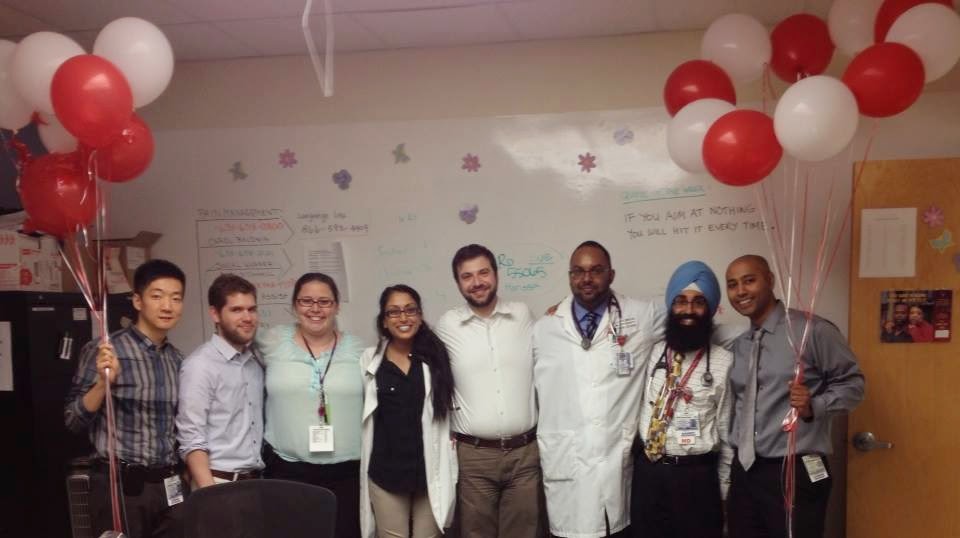
I had a few minutes so I thought I'd try and collect some of the many pictures taken at my last job that capture the spirit of learning combined with the fun and joy of eating together like a family.

At least a couple of times a month, we would hold pot lucks at our clinic while we did our Friday afternoon outpatient noon conference. They often a had a theme such as "Pi day"where we all made/bought some form of a pie.

The work we did in that clinic was often quite difficult but small events like these really made the work and learning process so wonderful!

Lot's of great memories and I miss all of you!


Labels: , , , , , , ,

Tuesday, February 17, 2015

The eager Salesman and the stubborn Doctor.

     I really don't enjoy going into a store with a planned purchase only to get hassled and cajoled into purchasing something different. The fact is, with so much information at our fingertips, I decide ahead of time what I want and the price I'm willing to pay.

     Recently, I dropped my smart phone in the toilet bowl.

(Take 1 minute to laugh at me.)

     This event forced me to run to my wireless store and purchase a new smart phone. Despite having done my research, my anticipated 10 minute purchase turned into a 45 minute battle of wills between an eager salesman and my practical sensibilities.

     He couldn't have been a nicer guy. In his mid twenties, he had energy and enthusiasm for his job that likely made him very successful. His great attitude won me over and I let him do his sales pitch despite fully knowing I only came in for 1 specific purpose that I wouldn't veer from. He used numbers, diagrams, compliments, (even mild insults!), jokes, clever colloquial lines all to convince me I was making a huge mistake not heeding his advice. In the end, he relented, went to the back of the store and came back with my phone.

     As he was ringing up my purchase on his tablet,  he made one last ditch effort to win me over. In the process, he asked me what I do for a living. I told him I was a physician and suddenly, the entire tone of our conversation changed.

He paused, gave me a forced smile as I watched the wheels spin in his eyes. For the 1st time I sensed the smallest hesitation in his sales pitch and instead of talking about his product, he came back with this:

"How do you treat vertigo?" 

     I felt bad that I made him expend a lot of energy  knowing he'd fail. I humored him and we switched roles. Standing in a quiet corner of the store, I began asking him all the questions I normally would. After a few minutes of trouble shooting, we changed the symptom description to "disequilibrium" instead of vertigo and I reassured him while encouraging further evaluation with his primary care doctor. He seemed grateful but I couldn't help notice a morose coming over him.

     He explained to me he always worries about something terrible happening to him just like his sister. I delved further to find out several years prior, his 16 year old sister died of a pulmonary embolism. His voice lost clarity as he fumbled around his tablet muttering how all the bad doctors ( pediatricians, ER etc)  missed the diagnosis. He chuckled recalling how an x-ray went missing but was subsequently found and clearly had abnormal findings. Although I didn't ask, I presumed the x-ray was later found as part of some litigation process.

     I couldn't imagine how it must have felt to lose a sister when you are a child yourself. I could understand the frustration and anger under his breath that probably took years to soothe. An unexpected death of a loved one is always a tragedy especially when it seems the answers are so obvious and in the hands of the physicians entrusted to figure it out. I felt terrible for him, as he pulled out his own smart phone to show me an old picture of her,

     As objective physicians we always contemplate alternatives. I didn't know the physicians that treated his sister, but I empathized with them a little bit We are taught very early on in our education that pulmonary embolism is one of the trickiest diagnosis and easy to miss. We are taught about pre-test probabilities and chest pain in a teenager is statistically much less likely to be a life threatening condition. I imagined that could have easily been me, a well meaning physician doing their due diligence and something terrible like this still happening. As a physician, we never get comfortable dealing with the death of a patient. It's even more difficult when there's an unexpected death and you're left wondering what else you could have done. These very personal emotions are occasionally twisted, tossed and turned through malpractice litigation ; a process after which physicians are left confused, numb and questioning their purpose. This is a burden many physicians carry to their own grave, quietly without any expectation of assistance or pity.

     As he finalized my purchase, I completed my thoughts coming to the conclusion that no matter what the circumstances were, he went through a tragic experience and nothing can change that. I was happy to see he survived  and had become a very good salesman with a good attitude and great smile. But on this day he didn't get the sale he wanted. I regained my connection to the digital world with a new smart phone. I'm hoping he regained the tiniest bit of faith that doctors despite being fallible, listen and care.

Labels: , , , ,

Sunday, February 15, 2015

Health Insurance ; A prerequisite to the American Dream

The American dream is alive and well. We still live in the land opportunity where hard work is the ticket to endless opportunities. On the contrary, bad health poses a major impediment towards fulfilling that dream. Besides the physical toll of an illness, the financial cost of an illness can make the American dream impossible to achieve. Millions of people without health insurance everyday face the spectre of their dream becoming a health care nightmare. Recently I got some great news about a family member who immigrated to the U.S a few years ago. A middle aged man with a wife and 2 kids, he came ready to do whatever it takes to secure a future for his family. An educated man, he struggled to find employment. He latched on to several different jobs that helped continue to build his skills but was given no health care benefits. He didn't qualify for Medicaid and couldn't afford private health insurance. Just like many Americans in this situation, his health took a backseat. But recently, he was finally able to secure a job that offered benefits including health insurance. He now had the security that seemed like a natural prerequisite towards pursuing his own American Dream. He took this opportunity to finally seek out world class healthcare. From a distance, I began to get caught up with what was happening with his health. Fortunately, he didn't have too many medical problems besides benign prostatic hyperplasia (BPH). It was significant enough that he was referred to a urologist. He felt lucky to find a local well renowned urologist with many positive reviews (both online and word of mouth) that also took his excellent new health insurance. After 1 visit, it seemed like he was appropriately placed on some medications to try to alleviate his symptoms. What was surprising is that he was also placed on brand name testosterone replacement. Immediately, skepticism towards testosterone replacement therapy began to engulf my thoughts. I began to wonder if my family member was another victim of the "Low T" marketing campaign. Furthermore, I was shocked to find out that within weeks of seeing this doctor, he was being offered greenlight laser prostatectomy. Granted I am looking at this case as an outsider. But without trying various types of medical therapy at optimal doses and for significant periods of time, the recommendation for surgery seemed very premature. Since then, my family member has been directed to a second opinion.
Health insurance is an extremely high priority issue for most Americans. It is the sensible thing to attain, whether it is to ensure wellness or treat illness that might otherwise derail a lifetime of hard work. But my family member's reward for obtaining health insurance wasn't good health but rather a glut of potentially wasteful and dangerous medical care. As we continue to expand health insurance in an attempt to cover all Americans and provide them access to care, we have to continue efforts towards curtailing health care that is not evidence based, wasteful and only serves to fulfill the American dream of providers and drug companies while taking advantage of hard working naive citizens. 

Labels: , , , , , , , ,

Monday, February 9, 2015

Don't hate the Anti-Vaxxer

     It's easy and convenient nowadays to take a few minutes to rally against the "Anti-Vaxxer" movement. With the recent measles outbreaks, there's no shortage of articles, memes, jokes and cartoons to share on blogs, Facebook, Twitter etc. But I'm going to throw a very small teeny tiny microscopic bone to the Anti-Vaxxer camp. I will do so with the disclaimer that as a primary care physician I think vaccines are an extremely important part of good health. Anyone that doesn't see their value, is misguided and perhaps misinformed.

    Having said that, there's no denying that the Anti-Vaxxer  movement  is real and unfortunately seems to be growing. They have quietly become a significant part of the general population. The reason for their growth is multifactorial, but the easiest targets are probably defrauded scientists, celebrities and politicians with dubious opinions. But the target that's probably hardest to identify is the one looking right back at us in the mirror.  When a problem afflicts society, the easiest thing to do is blame others. The introspective route asks us to look within to identify causes and offer solutions.
     How did we let this happen? The Anti-vaxxer movement is just another example of the growing mistrust and lack of faith in our doctors and healthcare system. There are many reasons for this. When it comes to vaccines, why aren't we, the trusted physicians able to educate and change their minds? Perhaps we are not living up to the true latin meaning of the word "Doctor" which is "to teach." Perhaps the modern doctor,  gathered and taught in traditional (antiquated?) methods are struggling with modern informed patients who challenge and question rather than accept paternalistic physician decision making. Perhaps we simply just don't have time to have a decent conversation with our patients about the importance of vaccines.
    Whatever the reasons, we need to figure out better ways to connect with this subset of our patients whose beliefs about vaccines post significant individual and community health risks. What we don't need to do is further alienate this population by kicking the proverbial horse while it's down. The amount of  seemingly joyous vitriol pouring from the medical community against anti-vaxxers is disappointing and at times bordering on classless. Social media is teeming with derogatory descriptions of this population.  I think this only furthers many people's views of rampant intellectual elitism in our doctors. The most disappointing stance on this issue is when doctors proclaim they will refuse to see patients who don't believe in vaccines. Hey genius, if you don't see that patient, then they definitely don't stand a chance of getting a vaccine!
   The anti-vaxxer type of population is something that has always existed in most medical practices. They represent a group of people who don't believe in the gospel you are preaching. I have patients who don't believe in cancer screenings, statins and a whole host of other great evidence based ideas. They can be frustrating and time consuming.  But they are still my patients and I will continue to respect them and care for them with the confidence to know I will eventually change some of their minds.

Labels: , , , , , ,

Monday, June 2, 2014

Fast Food Medicine

"Would you like fries with that?” 
"Would you like to upgrade to a large soda instead of a medium?"
“Would you also like an additional blood test for Lyme disease?”

Sure why not? I love fries!
And a larger drink? Heck yeah, if it's only a few cents more.
I'll also take that Lyme disease test, just to be on the safe side!

The above sounds like a great fulfilling experience.
You get delicious inexpensive food, served by very pleasant and efficient people that were also willing to cater to whatever you want. You also get a doctor who seems to really care and thorough by ordering a battery of tests. It's the kind of experience and place that anyone would want to keep coming back to, again and again.

This is not the typical experience many patients (consumers?!?) have when they interface with our general healthcare system. Healthcare is not inexpensive, not convenient at all and the quality of the product is variable. And in many cases the experience is very unpleasant.

"Necessity is the mother of all invention."

What started out as filling a void for overcrowded emergency rooms and unavailable primary care physicians, urgent centers have been flourishing. It's simple supply and demand. Supply of primary care doctors are dwindling and the demand for more convenient patient care is increasing. Now in any of your neighborhoods, you can get coffee, fast food and some "healthcare" rather quickly and merrily. 

I've gotten used to counseling my patients on the dangers of obesity and its association to fast food. Lately, I've had to start counseling my patients on the dangers of fast food medicine. Although I recognize their need and why they appeal to patients (consumers!?!), I have serious concerns about the impact Urgent Care centers have on healthcare at large. Just in the past few years, these are the types of issues I've noticed from care provided by such places.

Over prescription of antibiotics
Unnecessary use of broad antibiotics
Shot gun blood work with spurious findings
Recommendations to pursue unnecessary advanced imaging
Unnecessary recommendations to see specialists
Patient expectations for over treatment and extensive work ups

These are just broad generalizations but after a years, my patient sample size is growing.

I'm not a business man, but in the "for-profit" world" you do things that get you paid (x-rays, blood work?) and you give the consumer what they want to ensure return business. These are dangerous business concepts when applied to healthcare and urgent care centers are rapidly becoming the prime example of this. 

As the cost of our healthcare approaches 20% of our GDP and medical educators at all levels preach value and cost, urgent care centers, retail clinics and their profit incentives threaten to undermine this entire movement.

I'm not the only one that is worried about this.

The link below comes from a blog post on Kevinmd.com echoing similar sentiments. 


Labels: , , , ,

Thursday, February 27, 2014

A Wasteful Week

     I'm a bit of a backseat driver these days. As a result of the economy and the number of people who have lost insurance (and gained Medicaid) we're seeing a lot of new patients who previously had commercial insurance plans and were being seen by community providers that do not accept Medicaid. Some of them reluctantly come to our resident clinic, but the majority are very grateful for the opportunity to receive excellent comprehensive care from our well intentioned trainees during a difficult transition in their lives.
I've never really worked as a private practitioner in the community, but this influx of patients switching to our clinic has given me some (albeit very limited) perspective on the care they receive in the community with commercial insurances. For the most part, everyone receives excellent care and they often express disappointment that they have to leave their long standing doctor. But on several instances, when we investigate their past medical histories, we've been seeing several instances of what appears to be wasteful unnecessary care.

In 1 week, here is a sampling of a few of these cases.

1: Middle aged gentlemen in good health, well controlled high blood pressure and some family history of heart disease was getting yearly stress tests because " My doctor  was thorough and wanted to be sure."

2: Gentleman who got his first colonoscopy at age 47 because according to his wife "We had really good insurance."
 
3: Twenty something  year old female, with mild occasional anxiety was getting yearly EKG's as part of her "Annual Exam."
  
I know I'm looking at these cases as a backseat driver. Perhaps I was getting an incomplete history and there were good reasons why these tests were ordered. But my instincts, medical knowledge and perspective on our current healthcare system suggests it falls under the category of wasteful care.
Reuter's Report on Healthcare system waste 2009

We are all guilty of practicing wasteful care and it's a multi-factorial problem. It start's by changing our mindset towards healthcare by looking at things in terms of value. We also need to make a concerted effort towards following the evidence, and when the evidence is overwhelming, use validated clinical decision support tools.

Case 1: See number 2. Choosing Wisely (American College of Cardiology)
Case 2: USPTF Colon Cancer screening guidelines
Case 3: Rethinking the value of the annual exam

We also have to hold each other accountable for these problems, and sometimes that means being an annoying backseat driver with a computer and a blog :-)

Labels: , , ,

Thursday, January 2, 2014

Our healthcare and "The Wire"


A few months ago, I finally started watching "The Wire.” For anyone unfamiliar with it, “The Wire” is a police drama on HBO that takes place in Baltimore, Maryland. It takes a hard look at inner city drugs and violence from the multiple points of view of an incredible tapestry of characters. It's a wonderfully gripping show and I give kudos to the creator David Simon for painting this haunting and tragic picture of modern urban Americana.
I don't watch a lot of TV, but right now I can’t stop thinking about this show. The show has a lot of social commentary and I’m finding its messages everywhere around me. No, I don't work in the inner city, though I'm somewhat familiar with it. I grew up in a humble New York City neighborhood that over the years started to struggle with drugs and violence. I did my residency training in downtown Philadelphia, and as a young doctor saw many facets of inner city life from a medical perspective. Although I don't currently work or live in the harsh inner city streets, I do exist in a place that is failing its citizens just like "The Wire." Our healthcare system sometimes seems just as tough, destitute and hopeless as the streets of Baltimore as depicted on the show. 
Instead of street drugs, we have diseases in healthcare. But the story of "The Wire" isn't about the drugs itself, but rather how its omnipresence shapes the lives of the entire ecosystem. The same can be said for diseases in healthcare. Diseases are the constant in healthcare and how all the players deal with its presence is diverse and fascinating. But drugs in the show and diseases in healthcare are not the antagonists in these stories. The TV show makes this painfully clear. Any attempt to physically remove drugs from the streets by arresting the end users is an exercise in futility. In medicine simply fixing one artery, treating one infection, doing one CT scan or taking a pill, solves a problem temporarily for the end user  (the patient) but does little to answer the bigger question of why someone struggles to overcome a chronic illness or in the case of "The Wire" why citizens struggle to climb the social ladder out of the ghetto. 
The show also has an incredible cast of characters. Most of them have positive attributes and an innocence that is constantly challenged by drugs and violence. I feel for  these characters. As I watch them, I cross my fingers and hope they find a way out before the "the game" catches up with them. As a primary care physician, I peer into the lives of my patients just like the characters in the TV show. I get to know them, their hopes, dreams, and their intentions while they face difficult odds against conditions like morbid obesity, diabetes, psychiatric illnesses, HIV and heart disease. I cheer for my patients while hoping that my interventions will avert some catastrophic event in their life. In "The Wire" a teenagers’ dream to become something in this world may get derailed by a random act of violence that inevitably pulls them into a life of drugs. In my world, a heart attack, stroke or any other random medical malevolence sets of a chain reaction that often makes it very difficult to meaningfully recover from.
The show also shows the perspective of the police department, the good guys. I like to think I'm one of the good guys. Instead of the guardians of the law, I view myself as a guardian of health.  In the show, the police department is depicted as a bureaucratic mess with leaders pushing misaligned incentives and convincing the hard working street cops they are doing the right thing. Street level arrests (aka "rip and runs") of low level drug users and dealers are depicted as ineffective to curtailing drug violence and therefore a complete waste of resources. Nevertheless, arrests fill up stat sheets for the police department and numerically give the false impression that good is being done. As a primary care physician, I feel like the street cops, at the front lines of healthcare. Instead of arrests, I'm trying desperately trying to achieve numerical benchmarks which some might think are good indicators of excellent medical care. Although these numbers look good on paper, I question how effective they are in the grand scheme of changing healthcare outcomes and improving lives. True investigative work that looks deeply into patients’ lives to solve and treat root cause is not rewarded in our healthcare system nor are the investigators appreciated who take this approach in the show.
Finally, I've read that the creator of the "The Wire" views his show as a modern day Greek tragedy. Greek tragedies often describe a doomed people who exist at the mercy of angry, greedy, vain and selfish Olympus gods who hurl lightning bolts, pestilence and misery at their subjects. In “The Wire,” the modern gods come in many forms. Politicians, police commissioners, corporations, drug kingpins all have a responsibility to protect and help their followers, yet inevitably fail them time and time again to their own benefit. In my world, the gods are politicians, insurance companies, drug companies and perhaps the physicians themselves. In their efforts to serve, politicians fight over policy decisions while people remain without insurance. Insurance and drug companies continue to profit despite questionable business practices that often hurt average citizens. Too many physicians, despite their best intentions, mired in debt and bureaucracy blindly plunge ahead doing more and more in a fee for service world without ever stopping to see if we're not only helping but also hurting our patients.
Occasionally I get asked about the myriad of healthcare related TV shows and which one is the most realistic. The easy thing is to point to any show that has doctors in it, be it a comedy, drama or reality show. Though “The Wire” isn’t about healthcare, its themes are very relevant to what I see every day as a primary care physician. With one more season left to watch, I’ve unfortunately come to expect a tragic hopeless ending. With several seasons left of my own story in primary care I expect many tragic story lines. But in this case, hopelessness will never be in the script.

Labels: , , ,

Thursday, December 5, 2013

Top 10 reasons I use Twitter in Healthcare


I’ve been on Twitter for almost a couple of years now and when I talk to people about it, I still get a healthy dose of skepticism.
So I've put together a top ten list of why as a physician and medical educator, I use Twitter.

10: Connecting with Leaders
To be lead, you must know what your leaders are thinking. Twitter has made leaders accessible. Now, instead of spending time looking for their opinions or hoping to catch a handshake or meeting at a conference, they send their thoughts directly to me, in small increments of 140 characters, everyday!

9: Connecting with Followers
As physicians, you are a leader. Whether it ‘s in your office, your patient panel, your learners, your colleagues, your academic society, you have the opportunity (and responsibility? ) to lead and lead effectively. Twitter allows you to share your thoughts in small increments, reach a vast audience with minimal effort. Quoting #10, “To be lead, you must know what your leaders are thinking.”

8: Networking
The importance of professional networking cannot be understated. Twitter easily connects people with similar interests. In less than 2 years, I have been able to access a vast network of people interested in things that are important to me such as Primary Care, Medical Education, Social Media, Evidence Based Medicine and Healthcare Technology. In the past, networking for me occurred in spurts, at pre-determined locations over a finite period of time. With Twitter, networking happens 24/7, with little effort no matter where you are (and in your pajamas, while watching tv!).

7: It makes me an active learner.
All through my education I took notes. Writing things down helped solidify that piece of knowledge. A notebook was also useful for exams, reviewing and reinforcing information. Now instead of a notebook, I have a tablet and instead of a piece of paper, I use twitter. The 140 character limitations forces me to be succinct which makes my virtual notebook very easy to review.

6: I can educate the world
This is a grandiose statement, but Twitter makes it real. As a Medical Educator, I take pride in being able to influence the learners in my immediate proximity. With Twitter I can take all those notes  (See reason #7) and broadcast it to learners in other cities, states, countries and continents! Currently I’m using the the hashtag #sbmgr to broadcast what we’re learning in our Internal Medicine Grand Rounds every Wednesday 8:30 to 9:30 AM.

5: I can attend multiple conferences simultaneously, year round.
Until human cloning technology advances, Twitter is the best way to be at multiple places at once.  I wish I could attend every medical conference out there. But thanks to people who prescribe to reason #7, I can virtually attend other conferences through my smart phone, all throughout the year. There are thousands of people out there like myself, live tweeting from conferences. This year, I personally attended ACP and APDIM live tweeting from both. But in addition, while being back home, I followed the tweets from Kidney Week and Chest in the past couple of months.

4: It’s a forum for debate
Healthy debate is part of our lives as physicians. New guidelines and treatments are always coming up, and Twitter I get immediate access to viewpoints from a wide variety of people. I often get immediate feedback on my own opinions.

3: My mom taught me to share
We are all online, all the time. As a physician, I’m always finding a great journal article, an interesting blog,  or an important news article. Before twitter, I had no mechanism to share that, besides e-mailing to a small set of people or writing it down somewhere and hope that I have an opportunity to suggest it to people. Now, every website has a Twitter link. You see something cool, you can share it with a large audience with just a few clicks.

2: The world at any given moment
Whenever I have a free moment, Twitter  is my go to activity. In 2 minutes, I can scroll through a myriad of messages and get a burst of information from a network of my choosing.  So it’s whether pumping gas, waiting for an elevator, a 15 minute lunch, a commercial break during the football game, Twitter helps me use these small snippets of time, constructively.

1: It broadens my mind
In patient care we are emphasizing a team-based approach that values the roles of every individual in a healthcare team. The same can be said for my continuing medical education. I think I have something to learn, from everyone. As a result I follow folks in Internal Medicine, sub-specialties, family medicine, psychiatry, surgery and so on. I follow nurses, physical therapists, social workers and patient advocates. I follow patients (not my own) sharing the story of their medical conditions. I am learning something from everyone from the palm of my hand.

If this doesn’t get you interested in Twitter, here’s a a blog post from someone who’s listed 140 Health Care uses for Twitter
In addition, here’s another post to help you make the leap.

Top Twitter Myths and Tip  by Dr. Vineet Arora who is Director of GME Clinical Learning Environment Innovation and Assistant Dean of Scholarship & Discovery at the Pritzker School of Medicine for the University of Chicago.

Labels: , , ,